How Loud Is a Woodpecker? Decibel Levels Explained
Woodpecker drumming produces 60–103 dB — some species hit harder than a jackhammer relative to body size.
Reviewed by our team against authoritative public-health sources. See our editorial standards.
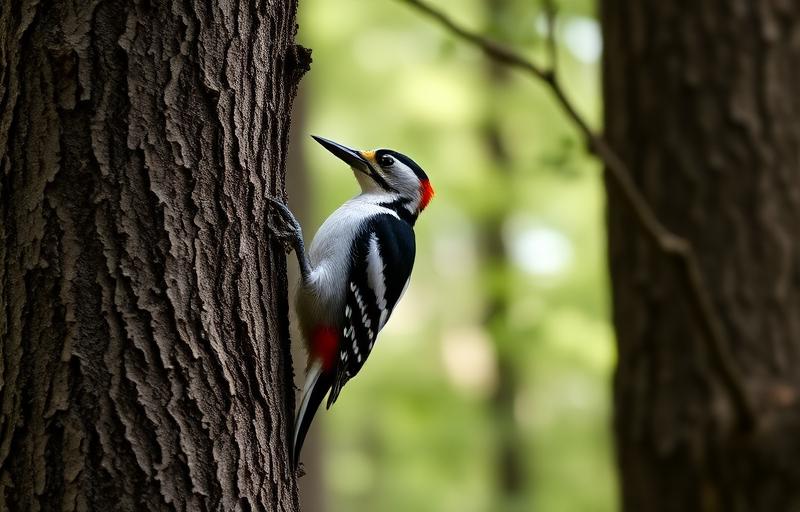
Woodpecker
60–103 dB
Safe exposure
4 minutes
Per NIOSH 85 dBA / 8 h reference (3 dB exchange rate)
Above 85 dB can damage hearing with prolonged exposure. Use ear protection.
Personalized verdict
Is this dangerous for you?
Woodpecker
82 dB
Typical
Your room
— dB
Tap Compare
Difference
—
Waiting
Audio is processed locally in your browser — nothing is recorded or sent. Prefer the full meter? Open Snap dB
Compare Woodpecker to:
Quick Answer
A decibel (dB) is a logarithmic unit used to measure sound intensity: an increase of 10 dB means ten times more sound energy.
Woodpecker drumming produces 60–103 decibels depending on species, surface, and distance. The pileated woodpecker can generate over 100 dB when drumming on resonant dead trees. When a woodpecker drums on your metal gutter or siding, it can exceed 90 dB inside the house.
📊 Similar in loudness to a garbage disposal (about 80 dB).
At a glance
| Typical range | 60–103 dB |
|---|---|
| Safety tier | Dangerous |
| Safe exposure (NIOSH REL) | 7.5 minutes |
| Audible at | ~20–30 ft |
Louder than a coffee shop (55 dB), quieter than a helicopter overhead at 100 feet (105 dB).
How these figures were determined: Values are based on published reference levels from NIOSH, OSHA, the WHO and the CDC, together with manufacturer specifications where available. Actual sound levels vary with distance, room acoustics, equipment condition and measurement method, and readings taken with a phone microphone are estimates rather than calibrated measurements.
Woodpecker Drumming Decibel Levels
Woodpecker drumming volume depends on species and the surface being struck. Small downy woodpeckers produce 60–75 dB at 1 meter. Red-bellied and hairy woodpeckers generate 75–90 dB. The large pileated woodpecker can produce 95–103 dB when hammering resonant dead wood at up to 20 strikes per second.
When woodpeckers drum on man-made surfaces like aluminum gutters, metal flashing, or hollow wood siding, the surface acts as an amplifier. Homeowners report that a woodpecker on a metal downspout produces startlingly loud reverberations at 80–95 dB inside the house — well above comfortable sleeping levels.
This might be louder than you think…
Noise Level: Woodpecker
Classification
Moderate
Safe Exposure
No time limit
How Woodpeckers Protect Their Brains
Woodpeckers experience deceleration forces of 1,200 g during each strike — forces that would cause severe brain injury in any mammal. They're protected by several adaptations: spongy bone in the skull absorbs shock, a hyoid bone wraps around the skull like a seatbelt, the brain fits tightly in the skull with minimal cerebrospinal fluid to prevent sloshing, and a third eyelid closes milliseconds before impact to prevent retinal damage.
Recent research has found microscopic brain damage (tau protein accumulation) in woodpecker brains, suggesting they may sustain mild damage that their rapid cell turnover can repair. This challenges the long-held belief that they're completely immune to impact effects.
Typical Sound Levels
Here's where it becomes dangerous…
The world's quietest room at Microsoft measures -20.6 dB — so quiet you can hear your own blood flowing.
Measure Your Environment
Use Snap Decibel Meter to estimate the sound level around you right now.
Open Noise MeterDeterring Woodpeckers from Your Home
If woodpeckers are drumming on your house, they're either foraging for insects (indicating a possible pest problem in your siding), establishing territory, or creating nest cavities. Solutions include: repairing any insect infestations that attract them, covering affected areas with hardware cloth, hanging reflective tape or aluminum pie plates as visual deterrents, and providing alternative drumming surfaces like purpose-built resonant boards placed away from the house.
The difference between 'fine' and 'damaging' is smaller than you think.
Understanding Woodpecker Noise Levels
Unlike mechanical noise that remains constant, woodpecker sound fluctuates with behavioral state, time of day, season, and social context. Peak vocalizations during territorial displays or distress calls can exceed the typical 60–103 dB range by 10–15 dB for brief bursts.
At 60–103 dB, you would need to speak loudly to be understood at arm's length. This volume triggers the acoustic reflex — your stapedius muscle contracts to dampen sound transmission through the middle ear — but this protective mechanism fatigues with sustained exposure and provides only 10–15 dB of attenuation.
Seasonal and circadian patterns affect woodpecker noise intensity. Many species vocalize most actively during dawn and dusk (crepuscular periods), and breeding seasons can amplify both the frequency and intensity of calls by 5–15 dB as individuals compete for mates.
The Biology Behind Woodpecker Vocalizations
Woodpecker sound production involves specialized anatomical structures that have evolved over millions of years. Most vertebrate vocalizations are produced by vibrating membranes (vocal cords, syrinx, or specialized skin patches) that convert respiratory airflow into acoustic energy. The size of these structures determines the fundamental frequency — larger animals generally produce lower-pitched calls.
The intensity of woodpecker vocalizations at 60–103 dB reflects significant metabolic investment. Producing loud calls requires sustained respiratory effort, and the energy cost scales exponentially with volume. A 10 dB increase in vocal output requires roughly 10× more metabolic energy, which is why animals typically reserve their loudest calls for high-stakes situations like territorial defense or mating.
Hearing sensitivity in animals often matches their own vocalization frequencies. Species that produce woodpecker sounds at 60–103 dB typically have peak hearing sensitivity in the same frequency range, ensuring that conspecifics can detect calls over the longest possible distance while filtering out environmental noise in other frequency bands.
Woodpecker vs. Common Noise Sources
Woodpecker noise at 60–103 dB matches a garbage disposal (80 dB) on the decibel scale. While the measured levels are equivalent, your brain perceives these sounds very differently based on their spectral content, temporal pattern, and your learned associations with each source.
On the quieter end, a busy restaurant registers about 65 dB — that's 17 dB below woodpecker, representing roughly 3× less perceived loudness. Moving louder, a motorcycle at 25 feet reaches 95 dB — 13 dB above woodpecker, approximately 2× louder to your ears.
In the animal kingdom, vocalization volume spans an enormous range — from a moth's ultrasonic click at 20 dB to a sperm whale's click at 230 dB underwater (the loudest biological sound recorded). Woodpecker at 60–103 dB fits among the loudest terrestrial animal sounds, rivaling howler monkeys and roosters.
Safe Exposure Duration for Woodpecker
According to NIOSH guidelines, the maximum safe exposure time at 103 dB is 7.5 minutes. This level is comparable to standing near a running chainsaw.
NIOSH Exposure Limits Reference
Seasonal Patterns of Woodpecker Noise
Woodpecker noise follows predictable seasonal rhythms driven by breeding cycles, migration patterns, and food availability. Peak vocalization periods typically coincide with mating seasons, when males compete for female attention through escalating vocal displays. During these periods, the sustained acoustic output can be 10–20 dB higher than baseline.
For people living near woodpecker habitats, understanding these seasonal patterns helps with planning. Breeding season noise typically lasts 4–12 weeks and follows a bell curve — gradually increasing, peaking for 2–3 weeks, then tapering off. Knowing when the peak occurs allows you to prepare with white noise machines, earplugs, or temporary schedule adjustments.
Hearing Protection Strategies for Woodpecker
Sustained exposure to woodpecker at 103 dB requires a deliberate hearing protection strategy. The National Institute for Deafness recommends the "3-E" approach: Engineering controls (reduce the source noise), Environmental modifications (increase distance, add barriers), and Equipment (wear proper hearing protection). Apply these in order — prevent the noise first, protect against the remainder.
Managing woodpecker noise requires different strategies than mechanical noise because the source is a living creature. Sound masking (white noise machines tuned to the vocalization frequency) is often more effective than blocking. For outdoor exposure, strategic landscaping — dense hedgerows, earth berms — provides both visual screening and 3–8 dB of sound attenuation.
- Plant dense hedgerows as natural sound barriers (5–8 dB reduction per 30m depth)
- For pets: consult a behaviorist about positive reinforcement training to reduce excessive vocalization
- Use foam earplugs at night if woodpecker disrupts sleep (NRR 25+ blocks most animal vocalizations)
- Keep interior doors closed between living areas and the noise source
- Use a white noise machine tuned to match woodpecker vocalization frequencies for effective masking
Test It Yourself: Measuring Woodpecker Noise
Long-term noise monitoring gives the most representative picture of woodpecker exposure. Set a recording device to capture overnight or multi-day data, then analyze for peak levels, frequency of vocalization bouts, and cumulative exposure. This approach reveals patterns that a single spot measurement would miss.
For sounds at 82 dB like woodpecker, most smartphone decibel meter apps provide reasonably accurate readings (typically within ±3–5 dB of professional equipment). For more precision, calibrate your app against a known reference sound or use a dedicated Type 2 sound level meter. The key to accuracy is consistent positioning and adequate sampling time.
How Woodpecker Noise Affects Your Health
The progression of hearing damage from woodpecker exposure follows a predictable pattern: first, temporary threshold shift (sounds seem muffled after exposure), then persistent tinnitus (ringing or buzzing that doesn't resolve), then permanent threshold shift (measurable hearing loss on audiometric testing). Early-stage damage is often unnoticed because the brain compensates by "filling in" missing signals from context.
Warning signs of overexposure to woodpecker noise include: ringing, buzzing, or hissing in the ears after exposure; speech sounding muffled or distant; difficulty following conversations in restaurants or social settings; and needing to gradually increase TV or headphone volume. If you experience any of these after exposure to woodpecker, reduce future exposure immediately and consult an audiologist.
Warning Signs of Overexposure
- Ringing, buzzing, or hissing in your ears after exposure to woodpecker
- Sounds seem muffled or distant after leaving the noisy environment
- Difficulty understanding speech in crowded or noisy settings
- Gradually increasing your TV or headphone volume over weeks
Measure Woodpecker Noise Yourself
Want to know how loud woodpecker is in your own environment? Use our free decibel meter to take a real-time reading, or check the complete decibel chart to see where 60–103 dB sits on the full scale. You can also compare sounds side by side or use the noise distance calculator to estimate levels at different distances.
🎯 Guess the Decibel Level
How loud do you think Woodpecker is? Drag the slider and find out!
Frequently Asked Questions
How loud is a woodpecker in decibels?
Woodpecker drumming ranges from 60–103 dB depending on species and surface material.
Why don't woodpeckers get brain damage?
Specialized skull structure, spongy bone, and a hyoid bone 'seatbelt' absorb the extreme impact forces.
How do I stop a woodpecker drumming on my house?
Check for insect infestations, cover affected areas with hardware cloth, and use reflective deterrents.
Explore More
Related Noise Guides
How Loud Is a Dog Bark? Decibel Levels Explained
Dog barking ranges from 80–90 dB — louder than most people expect. Learn which breeds bark loudest and how it affects hearing.
7 min readAnimal NoiseHow Loud Is a Rooster Crowing? Decibel Levels Explained
A rooster crows at 90–130 dB, rivaling the loudness of a chainsaw or jackhammer at close range.
5 min readAnimal NoiseHow Loud Is a Cicada? Decibel Levels Explained
Cicadas are nature's loudest insects at 80–120 dB, with mass emergences creating sound walls rivaling machinery.
5 min readAnimal NoiseHow Loud Is a Parrot? Decibel Levels Explained
Parrots produce 70–120 dB depending on species — large cockatoos and macaws rival rock concert volumes.
5 min readHow Does Woodpecker Compare?
Tap any sound to learn more about its noise level.
| Sound level | Sound | Vs. Woodpecker | Risk |
|---|---|---|---|
| 82 dB | Woodpecker (this page) | — | Moderate |
| 70 dB | The Complete Guide to Noise Levels and Decibels | −12 dB quieter | Moderate |
| 70 dB | Car | −12 dB quieter | Moderate |
| 78 dB | Traffic Noise | −4 dB quieter | Moderate |
| 85 dB | What Noise Level Is Safe for Humans | +3 dB louder | Moderate |
| 93 dB | Power Drill | +11 dB louder | Loud |
| 93 dB | Subway Train | +11 dB louder | Loud |
Compare With Other Sounds
See how this noise level compares to other everyday sounds.

Test Your Environment
Use Snap Decibel Meter to measure sound levels around you — free, private, and instant.
Start Noise Measurement