How Loud Is a Ceiling Fan? (Decibels Explained)
Ceiling fans: 30–55 dB — quiet, but some are surprisingly noisy.
Reviewed by our team against authoritative public-health sources. See our editorial standards.
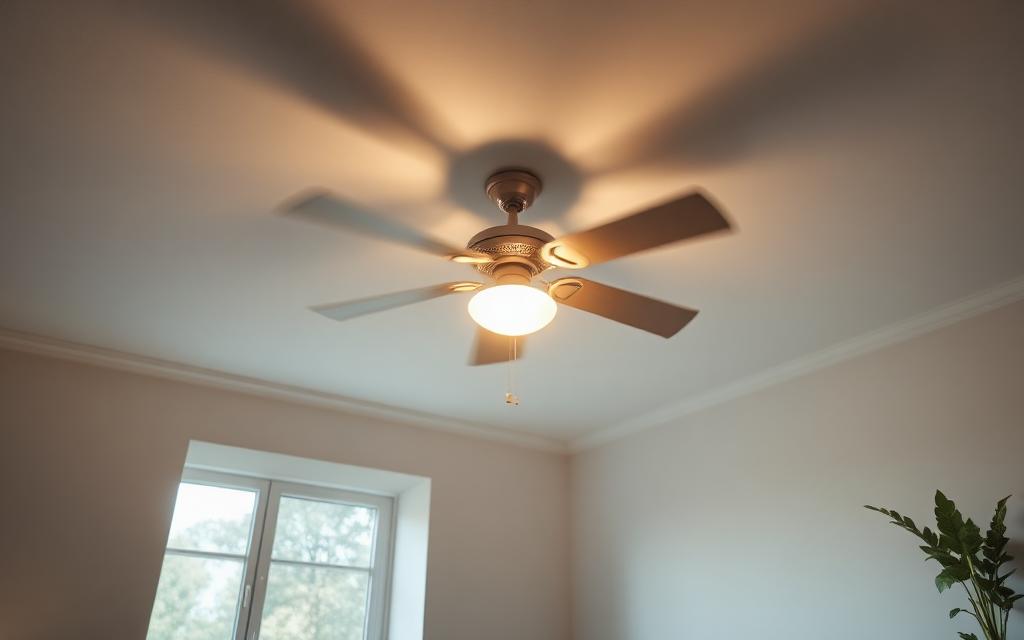
Ceiling Fan
30–45 dB
Safe exposure
All-day OK
Per NIOSH 85 dBA / 8 h reference (3 dB exchange rate)
Personalized verdict
Is this dangerous for you?
Ceiling Fan
38 dB
Typical
Your room
— dB
Tap Compare
Difference
—
Waiting
Audio is processed locally in your browser — nothing is recorded or sent. Prefer the full meter? Open Snap dB
Compare Ceiling Fan to:
Quick Answer
A decibel (dB) is a logarithmic unit used to measure sound intensity: an increase of 10 dB means ten times more sound energy.
Quality fans: 30–45 dB on medium. Cheap/aging fans: 50–55 dB with wobble. DC motor fans: 25–35 dB (quietest). No hearing risk, but affects sleep comfort.
📊 Similar in loudness to light rainfall on a window (about 40 dB).
At a glance
| Typical range | 30–45 dB |
|---|---|
| Safety tier | Safe |
| Safe exposure (NIOSH REL) | All-day OK |
| Audible at | ~a few feet |
Louder than a whisper at 5 feet (20 dB), quieter than moderate rainfall (50 dB).
How these figures were determined: Values are based on published reference levels from NIOSH, OSHA, the WHO and the CDC, together with manufacturer specifications where available. Actual sound levels vary with distance, room acoustics, equipment condition and measurement method, and readings taken with a phone microphone are estimates rather than calibrated measurements.
Fan Noise by Type
DC motor fans: 25–35 dB at medium — quieter than a whisper. Premium brands achieve this through precision-balanced blades and brushless motors.
AC motor fans: 35–50 dB due to electromagnetic hum. On high: some reach 50–55 dB. The loudest fans have problems: wobbling, clicking from loose hardware, humming from worn capacitors.
- Premium DC (low): 20–28 dB
- DC (medium): 28–35 dB
- AC (low): 30–40 dB
- AC (medium): 35–45 dB
- AC (high): 45–55 dB
- Wobbling: +5–15 dB extra
Most people are surprised by how loud this actually is…
Noise Level: Ceiling Fan
Classification
Safe
Safe Exposure
No time limit
What It Sounds Like
A well-balanced fan on low is essentially silent — just gentle air movement. Most people find this white noise beneficial for sleep.
On high speed, even quality fans produce noticeable turbulence. Larger fans (52–60 inches) move the same air at lower speeds, reducing noise. A noisy wobbling fan produces irregular ticking that is impossible to tune out.
Typical Sound Levels
Beyond this level, your hearing cells don't recover…
Your ears never turn off — even during sleep, your auditory system processes sounds and can trigger stress responses.
Measure Your Environment
Use Snap Decibel Meter to estimate the sound level around you right now.
Open Noise MeterChoosing a Quiet Fan
DC motors: 10–15 dB quieter, 70% less electricity, more speed settings. Worth the $50–150 premium for bedrooms.
Steeper blade pitch (12–14°) moves more air per revolution at lower speed. Solid wood blades are quieter than thin metal. Look for fans rated at 1.0 sone or below (~28 dB).
Fixing a Noisy Fan
Wobbling: blade balancing kit, tighten all screws. Clicking: tighten blade screws, check light globes and pull chains. Humming: likely a worn capacitor ($5–15 part) — or a dimmer causing motor hum (use fan-rated controllers only).
Comparisons
Quality fan at 30 dB ≈ quiet whisper. Fridge (35–45 dB) is often louder. AC indoor unit (40–55 dB) produces more noise. Standing fans (40–60 dB) are louder because the motor is closer.
The difference between 'fine' and 'damaging' is smaller than you think.
What Makes Ceiling Fan Sound the Way It Does
The noise produced by ceiling fan at 30–45 dB reflects specific physical processes — mechanical vibration, fluid turbulence, electrical oscillation, or impact forces — each with a characteristic frequency spectrum. Understanding the source mechanism helps predict how the sound will behave in different environments and which noise-reduction strategies will be most effective.
At 30–45 dB, ceiling fan sits in the "comfortable background" zone. The World Health Organization considers sustained levels below 55 dB safe for residential areas during daytime. You can carry on a normal conversation, concentrate on detailed tasks, and sleep without disruption alongside this sound.
The inverse square law governs how ceiling fan sound diminishes with distance. Every doubling of distance reduces the level by approximately 6 dB. At 45 dB measured at 1 meter, expect roughly 39 dB at 2 meters, 33 dB at 4 meters, and 25 dB at 10 meters.
Putting Ceiling Fan Noise in Perspective
The closest everyday comparison to ceiling fan at 30–45 dB is light rainfall on a window, which registers at 40 dB. Both sounds occupy the same energy band and present similar exposure considerations, though their frequency profiles and duration patterns create distinct listening experiences.
On the quieter end, a quiet library registers about 30 dB — that's 8 dB below ceiling fan, representing roughly 2× less perceived loudness. Moving louder, a quiet office reaches 45 dB — 7 dB above ceiling fan, approximately 2× louder to your ears.
Human hearing perception compresses the enormous physical range of sound into a more manageable subjective scale. The difference between 38 dB and 48 dB sounds like "about twice as loud" to most listeners, even though the actual energy difference is 10-fold. This compression is why small decibel differences feel significant — a 3 dB reduction removes half the sound energy.
Minimizing Ceiling Fan Noise Impact
At 45 dB, ceiling fan is well within safe levels and poses no hearing risk. The following tips focus on comfort optimization — creating the most pleasant acoustic environment rather than preventing health damage.
Simple environmental changes can reduce your effective exposure to ceiling fan noise. Closing a standard interior door reduces transmitted sound by 15–20 dB. Adding a rug to a hard floor absorbs 2–4 dB of reflected energy. Hanging heavy curtains adds 5–8 dB of high-frequency absorption. These modest steps compound to create meaningful noise reduction.
- Wear NRR 20+ hearing protection if ceiling fan exposure exceeds 85 dB
- Monitor cumulative daily exposure — multiple moderate sources compound over time
- Increase distance from ceiling fan when possible — every doubling cuts the level by 6 dB
- Measure ceiling fan noise with a smartphone app to establish your actual exposure level
- Add soft furnishings (rugs, curtains, upholstered furniture) to absorb reflected ceiling fan sound
How to Measure Ceiling Fan Sound Accurately
For reliable ceiling fan measurements, standardize your approach: measure at 1 meter distance, at ear height, with the microphone pointed toward the source. Run the measurement for at least 30 seconds and average multiple readings. Background noise should be at least 10 dB below your target to avoid interference.
When measuring quiet sounds like ceiling fan, background noise is your biggest challenge. Ensure the environment is at least 10 dB quieter than the source — turn off other appliances, close windows, and measure during quiet hours. Consumer smartphone apps have a noise floor of about 30–35 dB, which limits their usefulness for very quiet sounds.
The Wellness Impact of Ceiling Fan Sound
At 45 dB, ceiling fan presents no risk to your hearing or physical health. The human auditory system handles sounds below 70 dB comfortably and indefinitely. In fact, moderate ambient sound in the 40–60 dB range has been shown to improve creative thinking and reduce the stress associated with complete silence, which some people find unsettling or anxiety-inducing.
Understanding ceiling fan noise at 45 dB builds the acoustic awareness that protects you in genuinely dangerous situations. People who understand the decibel scale recognize hazardous noise faster, seek protection sooner, and make better decisions about their sound environment — whether choosing a restaurant, buying a home, or operating power tools.
Measure Ceiling Fan Noise Yourself
Want to know how loud ceiling fan is in your own environment? Use our free decibel meter to take a real-time reading, or check the complete decibel chart to see where 30–45 dB sits on the full scale. You can also compare sounds side by side or use the noise distance calculator to estimate levels at different distances.
🎯 Guess the Decibel Level
How loud do you think Ceiling Fan is? Drag the slider and find out!
Frequently Asked Questions
How loud?
30–45 dB quality fans. DC motors: 20–28 dB.
Why is mine loud?
Unbalanced blades, loose screws, worn capacitor, or failing bearing.
DC quieter?
Yes — 10–15 dB quieter than AC.
Affect sleep?
Smooth noise helps. Clicking/humming disrupts — fix it.
Explore More
Related Noise Guides
How Loud Is an Air Conditioner? (Decibels Explained)
Air conditioners produce 40–80 dB depending on type.
6 min readDecibel QuestionsIs 40 dB Loud? Understanding Quiet Sound Levels
40 dB is a quiet, comfortable sound level — similar to a library, light rainfall, or a quiet residential area at night.
4 min readDecibel QuestionsWhat Does 30 dB Sound Like? The Sound of Near-Silence
30 dB is whisper-quiet — the sound of a ticking clock, soft breathing, or rustling leaves. It's the ideal level for sleep.
4 min readHow Does Ceiling Fan Compare?
Tap any sound to learn more about its noise level.
| Sound level | Sound | Vs. Ceiling Fan | Risk |
|---|---|---|---|
| 38 dB | Ceiling Fan (this page) | — | Safe |
| 25 dB | Whisper in Decibels | −13 dB quieter | Safe |
| 25 dB | Wind Noise in Decibels | −13 dB quieter | Safe |
| 30 dB | Can Your Phone Measure Decibels | −8 dB quieter | Safe |
| 40 dB | What Noise Level Is Too Loud for Sleep | +2 dB louder | Safe |
| 50 dB | Snoring | +12 dB louder | Safe |
| 50 dB | Is 50 dB Loud | +12 dB louder | Safe |
Compare With Other Sounds
See how this noise level compares to other everyday sounds.


Test Your Environment
Use Snap Decibel Meter to measure sound levels around you — free, private, and instant.
Start Noise Measurement