How Loud Is a Dishwasher? What the Energy Label Declares
Dishwashers are one of the few sounds in the home with a genuinely documented number — but it is a sound power declaration, not a level measured at your kitchen table.
Reviewed by our team against authoritative public-health sources. See our editorial standards.
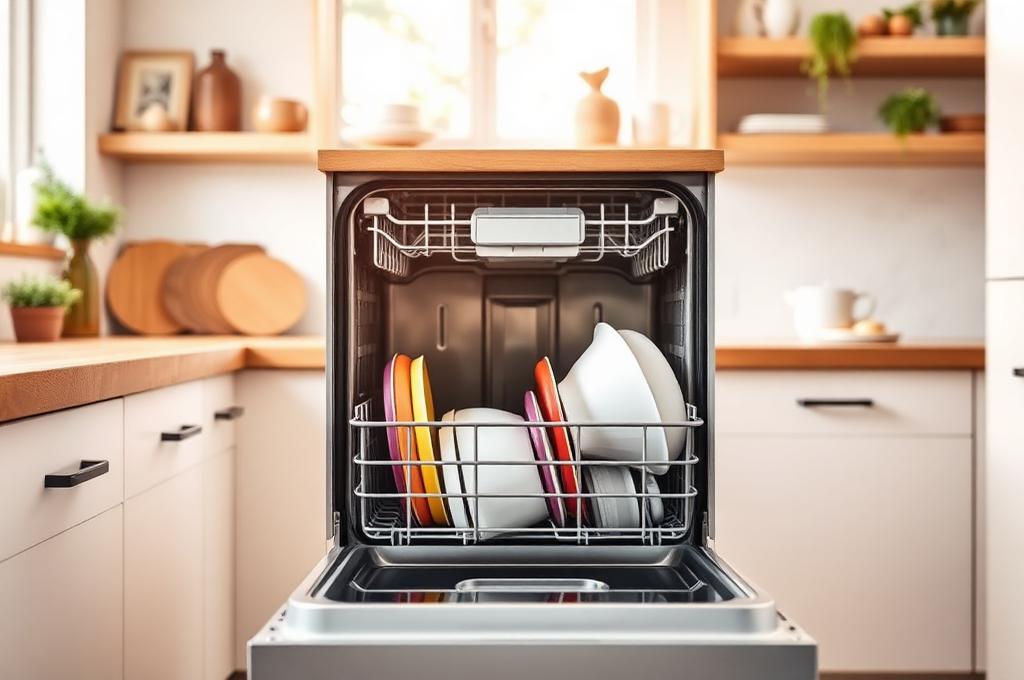
Dishwasher
49 dB
Safe exposure
All-day OK
Per NIOSH 85 dBA / 8 h reference (3 dB exchange rate)
Quick Answer
A decibel (dB) is a logarithmic unit used to measure sound intensity: an increase of 10 dB means ten times more sound energy.
Every dishwasher sold in the EU carries a declared airborne acoustical noise emission figure in dB(A) re 1 pW, plus a noise class from A to D, filed in the European Commission's EPREL database. The class bands are defined in Regulation (EU) 2019/2017: class A is below 39, B is 39 to under 45, C is 45 to under 51, and D is 51 or above. One published product fiche we checked, the EDESA EDB-6240-I SL, declares 49 dB(A) re 1 pW in class C. That figure is a sound power level for the eco programme — the total acoustic energy the machine radiates — and it is not the sound pressure level you would measure standing in the kitchen.
There is no single dishwasher level. The declared value belongs to a specific model on a specific programme, and the range across models sold today spans the full width of the A-to-D scale.
At a glance
| Typical range | 49 dB |
|---|---|
| Safety tier | Safe |
How these figures were determined: We quote declared sound power values as filed, with the unit (dB(A) re 1 pW) intact, and we do not convert them into a sound pressure level at any distance. No source we reviewed publishes a defensible power-to-pressure conversion method for dishwashers.
What the number on the label actually is
A dishwasher's declared noise figure is a sound power level. Sound power describes the total acoustic energy a source radiates, independent of the room it sits in, how far away you are standing, or what the walls are made of. It is a property of the machine.
Sound pressure — the quantity a sound level meter reads and the quantity your ears respond to — depends on all of those things. The two are different physical quantities with different reference values, and the energy label deliberately declares the first, because it is reproducible in a test laboratory and comparable between brands.
This is why the unit matters. A declared 44 dB(A) re 1 pW is not a promise that you will measure 44 dB(A) in your kitchen. It is a laboratory-determined emission figure, measured to the method in the IEC 60704 test-code series, filed by the manufacturer under EU labelling law.
The noise classes, as the regulation defines them
Regulation (EU) 2019/2017 sets four bands. They apply to the eco programme, which is also the programme used for the label's energy and water figures.
| Class | Declared sound power, dB(A) re 1 pW | What this means on a label |
|---|---|---|
| A | Below 39 | The quietest band currently defined |
| B | 39 to below 45 | Common on mid-range built-in models |
| C | 45 to below 51 | Includes the EDESA EDB-6240-I SL example at 49 |
| D | 51 and above | The loudest band defined by the regulation |
Band definitions taken from Annex II, Table 2 of the regulation. The class alone does not tell you the declared number, so the dB(A) re 1 pW figure on the product fiche is the more informative one.
Why the programme matters
The declared figure describes the eco programme. That programme runs long and gently by design, because the label rewards low energy and water use.
An intensive or short programme uses more spray pressure and more pump activity, and there is no requirement to declare a figure for it. So the label's number is the machine's quietest routine operating condition rather than its worst case, and the drain phase — which is what most people actually notice through a kitchen wall — is not separately declared at all.
None of the sources we reviewed publishes measured levels for individual dishwasher programme phases in a way that could be compared with the declared value.
What is not documented
We looked for a published sound pressure level for a dishwasher at a stated distance, with a stated weighting and stated room conditions, from an agency, standards body or peer-reviewed study. We did not find one.
Academic work on dishwasher acoustics exists — vibro-acoustic source analyses, sound-quality studies — but it studies noise paths and perception rather than publishing a reference level for a kitchen. So the honest position is that the declared sound power is well documented, and the level at your sink is not.
That is also why we will not tell you that a class-A dishwasher "sounds like a whisper". Whispers are quoted as sound pressure, the label is sound power, and putting the two in one sentence is the exact error this page exists to avoid.
If you want to measure your own
Measuring your dishwasher is genuinely useful for comparing states — door closed against door ajar, wash against drain, kitchen against next room — because the comparison does not depend on absolute accuracy.
What it cannot do is verify the label. Uncalibrated our meter reports A-weighted digital signal level in dBFS, which is relative rather than sound pressure; after a one-time local calibration it reports an estimated dBA figure. Neither is a sound power measurement, which requires either a reverberation room or a measurement surface of microphones around the source.
Frequently Asked Questions
How many decibels is a dishwasher?
Models sold in the EU declare a sound power figure between under 39 and 51-plus dB(A) re 1 pW, depending on the model. There is no single dishwasher level, and the declared figure is not a sound pressure level measured in your kitchen.
Is 44 dB quiet for a dishwasher?
It sits in class B under Regulation (EU) 2019/2017, which is toward the quieter end of what is currently sold. Remember the figure is sound power on the eco programme, not what a meter would read at the counter.
Why does my dishwasher sound louder than its label?
Three reasons, all legitimate: the label describes the eco programme, it declares sound power rather than the pressure at your ear, and it says nothing about how your cabinetry and floor transmit and reflect the sound.
Where can I find my model's declared figure?
In the EPREL product database maintained by the European Commission, or on the product information sheet the manufacturer must supply. The value appears with its unit, dB(A) re 1 pW.
Does the class tell me the number?
Only the band. Class C covers everything from 45 to just under 51, so two class-C machines can differ audibly. Look for the declared value itself.
Can I measure sound power with my phone?
No. Sound power determination requires a controlled acoustic environment and a defined array of microphone positions. A phone measures pressure at one point in your room.
Explore More
Related Noise Guides
How Loud Is a Washing Machine? Only the Spin Is Declared
The label answers a narrower question than most people are asking: it declares the spin, and nothing else.
5 min readNoise BasicsWhy Are Decibels Logarithmic? The Definition, Exactly
The decibel is not a unit of loudness. It is a ratio on a logarithmic scale, and once you see the definition the confusing rules stop being arbitrary.
8 min readHome Appliance NoiseHow Loud Is a Clothes Dryer? What Is Actually Declared
For dryers the evidence divides by geography: Europe requires a declared figure, and the United States requires nothing.
4 min readEvidence behind the levels on this page
Every sound level quoted above comes from one of the publications below. For each one we record what was actually measured, the microphone position or distance where that is stated, the metric used, and what the figure can and cannot tell you. Where a source did not state a condition, we say so rather than filling the gap.
European Commission · 2019 · EU regulation
- What was measured
- Noise class band definitions for declared airborne acoustical noise emission
- Reported level
- Class A below 39; B 39 to below 45; C 45 to below 51; D 51 and above
- Distance / position
- Not applicable — sound power is independent of distance
- Frequency weighting
- A-weighted sound power, dB(A) re 1 pW
- Conditions
- Eco programme, per the test conditions referenced by the regulation
- Supports on this page
- The class table and the statement that the label declares sound power for the eco programme
- Limitations
- Defines classes only. The regulation does not publish a sound pressure level at any listening position, and no conversion to one is provided.
Product information sheet, dishwasher model EDB-6240-I SL (EDESA/CATA Electrodomésticos)
European Commission — EPREL product database · Official regulatory database entry (manufacturer declaration)
- What was measured
- Declared airborne acoustical noise emission for one named model
- Reported level
- 49 dB(A) re 1 pW, noise class C
- Distance / position
- Not applicable
- Frequency weighting
- A-weighted sound power
- Conditions
- Eco programme, declared under Regulation (EU) 2019/2017
- Supports on this page
- The worked example of a real declared value and its class
- Limitations
- A manufacturer self-declaration for a single model filed to the regulatory database, not an independent verification measurement, and not representative of dishwashers generally.
IEC 60704-2-3, test code for the determination of airborne acoustical noise — particular requirements for dishwashers
International Electrotechnical Commission · International test standard
- What was measured
- The standardised laboratory method underlying declared dishwasher sound power values
- Reported level
- Method only — the standard publishes no universal level
- Distance / position
- Standardised measurement surface positions defined by the method
- Frequency weighting
- A-weighted, within the IEC 60704 sound power framework
- Conditions
- Controlled laboratory acoustic environment
- Supports on this page
- The explanation of why the declared figure is reproducible and comparable between brands
- Limitations
- We did not obtain the full standard text, so we do not quote its microphone geometry or tolerances. Its role here is to establish that a defined method exists.
Levels on this page are published measurements, quoted with the position and conditions their source states. See our editorial standards for how we source and review noise data.
Test Your Environment
Use Snap Decibel Meter to measure sound levels around you — free, private, and instant.
Start Noise Measurement