What Does 80 dB Sound Like? The Edge of Caution
80 dB is the alarm clock that wakes you, the garbage disposal that fills the kitchen, and the traffic that demands closed windows. It's louder than you think.
Reviewed by our team against authoritative public-health sources. See our editorial standards.

Quick Answer
A decibel (dB) is a logarithmic unit used to measure sound intensity: an increase of 10 dB means ten times more sound energy.
80 dB sounds like a ringing alarm clock, a garbage disposal, or standing near a busy four-lane road. It is genuinely loud — you need to raise your voice to converse. While not immediately dangerous, 80 dB is just 5 dB below the hearing damage threshold.
📊 Similar in loudness to a garbage disposal (about 80 dB).
At a glance
| Typical range | 80 dB |
|---|---|
| Safety tier | Moderate |
| Safe exposure (NIOSH REL) | All-day OK |
Louder than a vacuum cleaner at 10 feet (75 dB), quieter than a food blender running (85 dB).
How these figures were determined: Values are based on published reference levels from NIOSH, OSHA, the WHO and the CDC, together with manufacturer specifications where available. Actual sound levels vary with distance, room acoustics, equipment condition and measurement method, and readings taken with a phone microphone are estimates rather than calibrated measurements.
What 80 dB Really Sounds Like
Eighty decibels is the volume that makes you instinctively raise your voice. When your alarm clock goes off at arm's length, that jarring ring designed to cut through sleep is approximately 80 dB. When you flip on the garbage disposal, the grinding roar that fills the kitchen is 80–85 dB.
At 80 dB, sound stops being background and becomes foreground. It fills the room, competes with conversation, and demands attention. You cannot ignore it the way you can ignore 60 dB conversation or 50 dB ambient hum.
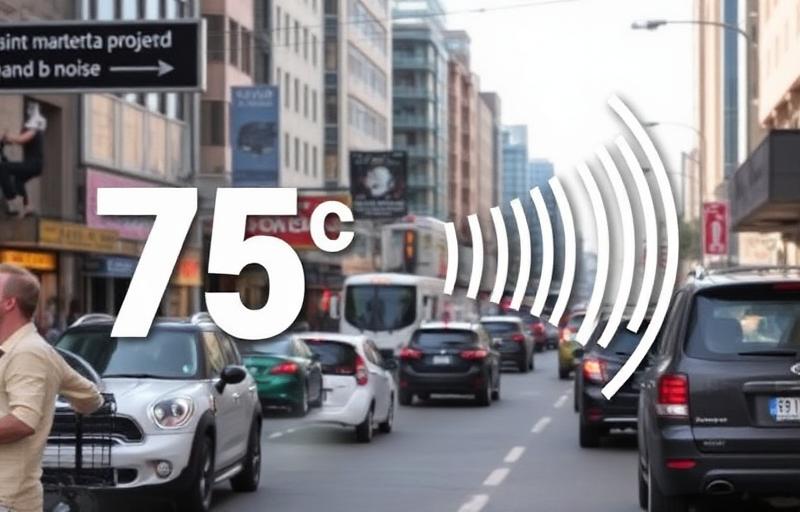
Standing on a sidewalk next to a four-lane road during rush hour, the continuous flow of traffic produces 75–85 dB. Add a truck or bus, and peaks touch 85–90 dB. This is the sound world of urban living at its most intense.
Most people are surprised by how loud this actually is…
Noise Level: 80 dB
Classification
Moderate
Safe Exposure
No time limit
Common 80 dB Sounds
The variety of 80 dB sources might surprise you. Many ordinary household activities briefly reach this level — and some sustain it. Understanding which everyday sounds hit 80 dB helps you develop an intuitive noise awareness that protects your hearing long-term.
- Alarm clock: 80 dB
- Garbage disposal: 80–85 dB
- Busy road from sidewalk: 75–85 dB
- Restaurant during peak hours: 78–85 dB
- Window AC on full: 75–80 dB
- Food processor on pulse: 80–85 dB
- Electric razor: 75–80 dB
- Hand vacuum on turbo: 80–85 dB
Typical Sound Levels
Beyond this level, your hearing cells don't recover…
Your ears never turn off — even during sleep, your auditory system processes sounds and can trigger stress responses.
Measure Your Environment
Use Snap Decibel Meter to estimate the sound level around you right now.
Open Noise MeterWhy 80 dB Is the Caution Zone
At 80 dB, you are just 5 dB — one small notch — below the 85 dB hearing damage threshold. While NIOSH does not set a formal time limit at 80 dB, the margin of safety is slim. Extended daily exposure (8+ hours) at 80 dB warrants awareness.
Research links chronic 80+ dB exposure to elevated stress hormones, cardiovascular strain, and cognitive fatigue — even without hearing damage. Your ears may survive, but your body's stress response system reacts to sustained loud noise.
The practical implication: if your workplace, commute, or home environment regularly hits 80 dB, consider noise reduction strategies or periodic quiet breaks.
The Logarithmic Reality of 80 dB
On the perceived loudness scale, 80 dB sounds roughly twice as loud as 70 dB and four times as loud as 60 dB (normal conversation). This exponential perception is why 80 dB feels dramatically different from 60 dB despite a seemingly small numerical gap.
In terms of acoustic energy, 80 dB carries 100 times more sound power than 60 dB and 10 times more than 70 dB. This energy differential explains why moving from a quiet room to a busy street feels like a dramatic shift — because physically, it is.
The logarithmic nature of the decibel scale means that small reductions yield meaningful results. Closing a window to reduce traffic noise by 10 dB cuts perceived loudness in half. Adding a rug to a hard-floored room can reduce reverberant noise by 3–5 dB.
Know Your Noise Level
Use Snap Decibel Meter to measure your daily environments. You may discover that your kitchen peaks at 80+ dB during cooking, your commute sustains 78–85 dB, or your gym pushes 85–95 dB. Awareness is the first step to better noise management.
A simple habit of checking noise levels at different points during your day builds the acoustic awareness that protects your hearing. The 80 dB zone is where informed decisions make the biggest difference — it is the boundary between comfortable and concerning.
The difference between 'fine' and 'damaging' is smaller than you think.
Reading 80 dB in Context
A reading of 80 dB tells you how much acoustic energy reaches the microphone, but not what produced it. The same level can come from a nearby quiet source or a distant loud one, so context matters as much as the number. Since decibels are logarithmic, adding 10 dB means ten times the sound energy and about twice the perceived loudness.
In practical terms, 80 dB is close to a garbage disposal, which sits at about 80 dB and is generally described as uncomfortable long-term. That reference is a useful anchor: if you can picture how that sound feels in a room, you have a reasonable sense of what 80 dB means.
Levels in this region also depend heavily on distance. Sound spreads out as it travels, and in free-field conditions each doubling of distance from a point source removes roughly 6 dB. Indoors, reflections from hard walls, floors and windows work in the opposite direction and can add several decibels to the same source.
Published reference levels like these come from occupational and public-health sources — NIOSH, OSHA, the WHO and the CDC — measured with calibrated, A-weighted instruments. Readings you take with a phone are useful for comparing one environment with another, but they are relative estimates rather than calibrated measurements, so treat small differences with caution.
How 80 dB Compares to Everyday Sounds
On the quieter side, a vacuum cleaner at 10 feet registers about 75 dB — 5 dB below 80 dB. On the louder side, a food blender running reaches roughly 85 dB, which is 5 dB above it. Because 10 dB is heard as about twice as loud, those gaps translate into clearly different listening experiences rather than minor variations.
Two sounds at the same measured level can still feel different. Frequency content, how steady the sound is, and how much you associate it with something unpleasant all shape perception. That is why 80 dB from a steady fan and 80 dB from an intermittent, high-pitched source rarely feel equally intrusive even though a meter reports the same number.
If you want to place 80 dB on the full scale, the decibel chart lists reference levels from near-silence up to immediate-damage territory, and the sound comparison tool lets you line up two sounds side by side.
Keeping Everyday Noise Near 80 dB Comfortable
While 80 db at 80 dB doesn't require hearing protection, managing this noise improves comfort, reduces stress, and preserves the quiet that supports concentration, sleep, and cardiovascular health. The strategies below focus on environmental modifications rather than personal protective equipment.
Simple environmental changes can reduce your effective exposure to 80 db noise. Closing a standard interior door reduces transmitted sound by 15–20 dB. Adding a rug to a hard floor absorbs 2–4 dB of reflected energy. Hanging heavy curtains adds 5–8 dB of high-frequency absorption. These modest steps compound to create meaningful noise reduction.
- Increase distance from 80 db when possible — every doubling cuts the level by 6 dB
- Measure 80 db noise with a smartphone app to establish your actual exposure level
- Add soft furnishings (rugs, curtains, upholstered furniture) to absorb reflected 80 db sound
- Close doors and seal gaps between rooms to reduce transmitted noise by 15–25 dB
- Wear NRR 20+ hearing protection if 80 db exposure exceeds 85 dB
Measuring Noise Near 80 dB: Methods and Limits
To check whether your environment reaches 80 dB, measure where you actually spend time rather than right at the source, keep the microphone clear of clothing and hands, and let the reading settle for at least 30 seconds so short bursts do not dominate. Note the average level as well as the loudest moments — they answer different questions.
Phone-based measurements have real limits. Microphones vary between models, browsers may apply automatic gain control or noise suppression, and there is no absolute calibration reference. Snap Decibel Meter is unweighted and ambient-referenced, so it is best used to compare environments and track changes rather than to certify an absolute figure. For compliance work, a Type 2 sound level meter is the appropriate instrument.
If you need levels at a different distance than you can safely measure, the noise distance calculator applies the inverse-square relationship for you, which is often more reliable than trying to measure close to a loud source.
How Noise Around 80 dB Affects Well-Being
Levels around 80 dB are not associated with hearing damage at any realistic duration, but they still affect people. The WHO links sustained night-time noise well below hearing-risk levels to disturbed sleep, and continuous background noise in this region is a common cause of reduced concentration in offices and classrooms.
For sleeping rooms the WHO guideline is around 30 dB of continuous indoor noise, which is considerably quieter than most urban bedrooms. If your measurements sit above that, soft furnishings, heavier curtains and sealing gaps around windows and doors usually help more than any single device change.
Check Whether Your Environment Reaches 80 dB
Want to know whether your own environment reaches 80 dB? Use our free decibel meter to take a real-time reading, or check the complete decibel chart to see where 80 dB sits on the full scale. You can also compare sounds side by side or use the noise distance calculator to estimate levels at different distances.
🎯 Guess the Decibel Level
How loud do you think 80 dB is? Drag the slider and find out!
Frequently Asked Questions
Is 80 dB dangerous?
Not immediately, but it's just 5 dB below the damage threshold. Prolonged daily exposure warrants caution.
Is 80 dB twice as loud as 70 dB?
In perceived loudness, approximately yes. A 10 dB increase sounds about twice as loud.
Do I need earplugs at 80 dB?
Not strictly necessary, but recommended for extended exposure (8+ hours).
Explore More
Related Noise Guides
Is 80 dB Loud? When Noise Starts Getting Serious
80 dB is genuinely loud — think alarm clock or busy traffic. It's approaching the danger zone. Here's what you need to know.
5 min readDecibel QuestionsWhat Does 90 dB Sound Like? Entering the Danger Zone
90 dB is the noise of a lawn mower, food blender, or subway train. It's loud, attention-grabbing, and can damage hearing within 2 hours.
5 min readHearing SafetyIs 85 dB Dangerous? The Critical Hearing Damage Threshold
85 dB is where hearing damage begins. It's the most important number in noise safety — and most people have no idea they're exposed to it daily.
6 min readHow Does 80 dB Compare?
Tap any sound to learn more about its noise level.
| Sound level | Sound | Vs. 80 dB | Risk |
|---|---|---|---|
| 80 dB | 80 dB (this page) | — | Moderate |
| 68 dB | Crowd Noise | −12 dB quieter | Moderate |
| 68 dB | Treadmill | −12 dB quieter | Moderate |
| 70 dB | The Complete Guide to Noise Levels and Decibels | −10 dB quieter | Moderate |
| 85 dB | What Noise Level Is Safe for Humans | +5 dB louder | Moderate |
| 93 dB | Power Drill | +13 dB louder | Loud |
| 93 dB | Subway Train | +13 dB louder | Loud |
Compare With Other Sounds
See how this noise level compares to other everyday sounds.


Test Your Environment
Use Snap Decibel Meter to measure sound levels around you — free, private, and instant.
Start Noise Measurement