How Loud Are Fireworks? (Decibel Levels + Safety)
Fireworks can reach 140–175 dB at the launch point. Learn what that means for your hearing and how to enjoy them safely.
Reviewed by our team against authoritative public-health sources. See our editorial standards.
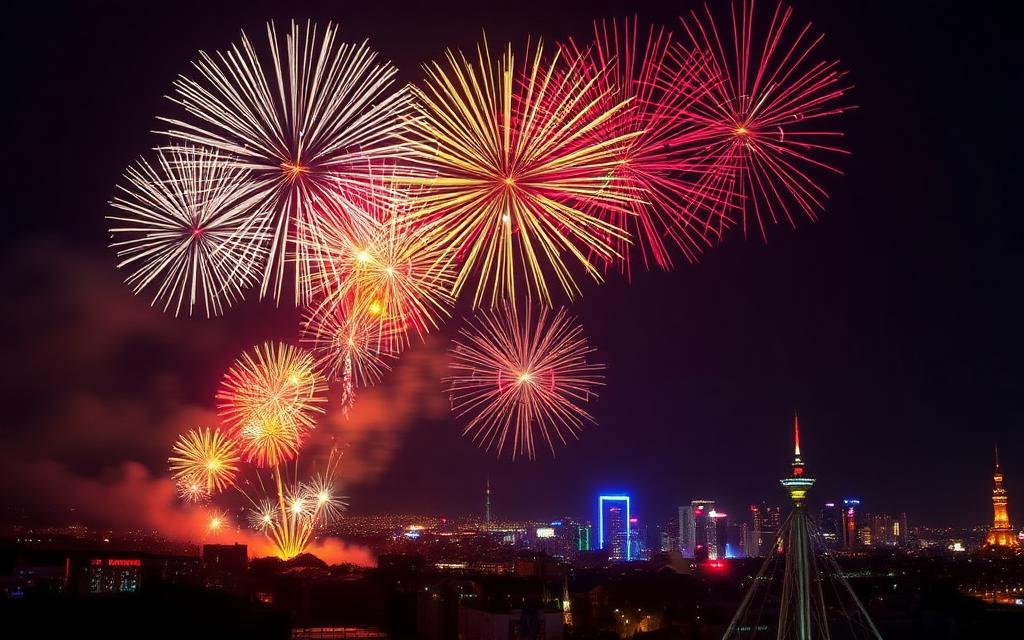
Quick Answer
A decibel (dB) is a logarithmic unit used to measure sound intensity: an increase of 10 dB means ten times more sound energy.
Professional fireworks reach 150–175 dB at launch and 120–150 dB for nearby spectators. Consumer fireworks produce 90–130 dB. Hearing protection is recommended for anyone within 150 meters of a display.
📊 Louder than a gunshot at close range (140 dB).
Prolonged exposure above 85 dB can damage hearing.
At a glance
| Typical range | 150–175 dB |
|---|---|
| Safety tier | Dangerous |
| Safe exposure (NIOSH REL) | Immediate risk |
| Audible at | ~50+ ft |
Louder than a gunshot at close range (140 dB) — near the top of the reference scale.
How these figures were determined: Values are based on published reference levels from NIOSH, OSHA, the WHO and the CDC, together with manufacturer specifications where available. Actual sound levels vary with distance, room acoustics, equipment condition and measurement method, and readings taken with a phone microphone are estimates rather than calibrated measurements.
How Loud Are Fireworks in Decibels?
Fireworks are among the loudest sounds most people experience in their lifetime. A professional aerial shell detonating at its burst point produces 150 to 175 decibels — louder than a jet engine and approaching the force of a shockwave.
For spectators at a typical viewing distance of 150–300 meters, the sound drops to roughly 90–120 dB. That is still as loud as a rock concert or an ambulance siren, sustained in rapid bursts over 15–30 minutes.
Consumer fireworks like bottle rockets, firecrackers, and roman candles are smaller but far from quiet. A standard firecracker at 3 meters produces approximately 130–150 dB — well above the threshold of pain.
Your ears can't tell you the real danger level here…
Noise Level: Fireworks
Classification
Dangerous
Safe Exposure
Immediate risk
What Fireworks Sound Like Up Close vs. Far Away
Standing near the launch site of a professional display is a full-body experience. The detonations are not just heard — they are felt as concussive pressure waves that thump your chest and vibrate the ground beneath you. Your ears ring after each burst.
At a comfortable viewing distance (200+ meters), fireworks sound like a series of sharp cracks and booms with a satisfying rumble that echoes off buildings and hillsides. The sound arrives slightly after the visual explosion, creating the familiar delay.
Inside a house with windows closed during a neighborhood fireworks session, levels typically drop to 60–80 dB — still clearly audible and potentially disruptive for sleeping children and pets.
- Professional aerial shells at burst: 150–175 dB
- Spectator at 150 meters: 100–120 dB
- Consumer firecracker at 3 meters: 130–150 dB
- Inside a house during neighborhood display: 60–80 dB
Typical Sound Levels
This is the point where hearing damage starts…
Over 1 billion young people worldwide risk hearing loss from unsafe listening levels on personal audio devices.
Measure Your Environment
Use Snap Decibel Meter to estimate the sound level around you right now.
Open Noise MeterCan Fireworks Damage Your Hearing?
Yes — fireworks are among the most common causes of recreational hearing damage, especially for children. A single firecracker at close range (130+ dB) can cause immediate temporary or permanent hearing loss.
The impulsive nature of fireworks makes them especially dangerous. Unlike sustained noise from machinery, fireworks deliver sudden acoustic energy that the ear's protective reflexes cannot respond to quickly enough.
Children's ear canals are smaller, which amplifies sound pressure. The American Academy of Pediatrics recommends keeping children at least 150 meters from professional displays and providing ear protection for closer viewing.
- Safe viewing distance: 150+ meters for professional displays
- Ear protection recommended: foam earplugs (NRR 25+) for anyone closer
- Children: extra caution — smaller ear canals amplify pressure
- Pets: keep indoors with white noise; dogs hear fireworks at far greater perceived volume
How Fireworks Compare to Other Loud Sounds
To appreciate how extreme fireworks are on the decibel scale, consider these comparisons. A normal conversation at 60 dB is perceived as roughly 64 times quieter than a firecracker at 130 dB.
Even a rock concert at 110 dB is significantly quieter than a large aerial shell. The only common sounds louder than professional fireworks are gunshots and explosive demolitions.
Why Firework Noise Awareness Matters
Every July 4th and New Year's Eve, emergency departments see a spike in acoustic trauma cases from fireworks. Many victims are bystanders who did not expect the volume, or children whose parents underestimated the risk.
Beyond immediate hearing damage, fireworks pose cumulative risk for professionals. Pyrotechnicians, military personnel, and event workers who experience repeated displays without protection suffer measurable high-frequency hearing loss over their careers.
Your daily noise exposure might already exceed safe limits.
Fireworks Noise: The Complete Breakdown
Sound at 150–175 dB from fireworks interacts with your environment in predictable ways. Hard surfaces reflect it, soft surfaces absorb it, barriers block it (with some diffraction around edges), and distance attenuates it. These fundamental acoustic principles apply universally and form the basis of every noise control strategy.
Noise at 150–175 dB from fireworks exceeds the maximum level that any regulatory body considers safe for unlimited exposure. At this intensity, sound energy is sufficient to physically damage the stereocilia (hair-like structures) on inner ear sensory cells. These structures do not regenerate in mammals — every exposure above safe limits contributes to permanent, cumulative hearing loss.
Room acoustics have a major impact on how loud fireworks actually sounds. Hard, reflective surfaces (tile, glass, concrete) create reverberation that can increase the effective level by 5–10 dB. Soft materials like curtains, carpet, and upholstered furniture absorb sound waves and make the same source noticeably quieter.
Sound Comparison: Fireworks on the Decibel Scale
The decibel scale is logarithmic — each 10 dB increase represents a tenfold jump in sound energy and roughly a doubling of perceived loudness. At 150–175 dB, fireworks carries 19,952,623,149,688,828× more acoustic energy than the threshold of hearing (0 dB), placing it in a well-characterized region of the audible spectrum.
Safe Exposure Duration for Fireworks
According to NIOSH guidelines, the maximum safe exposure time at 175 dB is Immediate risk. This level can cause instant pain and hearing damage.
NIOSH Exposure Limits Reference
Protecting Your Hearing from Fireworks Noise
Sustained exposure to fireworks at 175 dB requires a deliberate hearing protection strategy. The National Institute for Deafness recommends the "3-E" approach: Engineering controls (reduce the source noise), Environmental modifications (increase distance, add barriers), and Equipment (wear proper hearing protection). Apply these in order — prevent the noise first, protect against the remainder.
The most effective noise reduction combines source treatment, path interruption, and receiver protection — the "source-path-receiver" model used by acoustic engineers. For fireworks at 175 dB, start at the source (can you reduce the noise output?), then address the path (can you add distance, barriers, or absorption?), and finally protect yourself (hearing protection, time limits).
- Close doors and seal gaps between rooms to reduce transmitted noise by 15–25 dB
- Wear NRR 20+ hearing protection if fireworks exposure exceeds 85 dB
- Monitor cumulative daily exposure — multiple moderate sources compound over time
- Increase distance from fireworks when possible — every doubling cuts the level by 6 dB
- Measure fireworks noise with a smartphone app to establish your actual exposure level
Measuring Fireworks Noise: Methods and Tools
To measure fireworks noise as accurately as possible, use a dedicated Type 2 sound level meter or a calibrated smartphone app such as NIOSH SLM. Snap Decibel Meter gives you a fast relative estimate — useful for comparing environments, but uncalibrated and unweighted. Position the device at 1 meter from the source, at the height where you'd normally hear it. Take readings over 30–60 seconds and note both average (Leq) and peak (Lmax) values.
Measuring loud sounds like fireworks at 163 dB requires caution — the measurement process itself exposes you to potentially damaging noise. Wear hearing protection during measurement sessions, use a remote microphone or tripod placement when possible, and limit measurement duration to the minimum needed for representative data.
The Medical Impact of Fireworks Sound
The progression of hearing damage from fireworks exposure follows a predictable pattern: first, temporary threshold shift (sounds seem muffled after exposure), then persistent tinnitus (ringing or buzzing that doesn't resolve), then permanent threshold shift (measurable hearing loss on audiometric testing). Early-stage damage is often unnoticed because the brain compensates by "filling in" missing signals from context.
Warning signs of overexposure to fireworks noise include: ringing, buzzing, or hissing in the ears after exposure; speech sounding muffled or distant; difficulty following conversations in restaurants or social settings; and needing to gradually increase TV or headphone volume. If you experience any of these after exposure to fireworks, reduce future exposure immediately and consult an audiologist.
Warning Signs of Overexposure
- Ringing, buzzing, or hissing in your ears after exposure to fireworks
- Sounds seem muffled or distant after leaving the noisy environment
- Difficulty understanding speech in crowded or noisy settings
- Gradually increasing your TV or headphone volume over weeks
Measure Fireworks Noise Yourself
Want to know how loud fireworks is in your own environment? Use our free decibel meter to take a real-time reading, or check the complete decibel chart to see where 150–175 dB sits on the full scale. You can also compare sounds side by side or use the noise distance calculator to estimate levels at different distances.
🎯 Guess the Decibel Level
How loud do you think Fireworks is? Drag the slider and find out!
Hearing Safety
Fireworks regularly exceed 120 dB — well beyond the threshold of pain. Always wear ear protection and maintain safe distance, especially for children.
Frequently Asked Questions
How many decibels is a firework?
Professional fireworks reach 150–175 dB at the burst point. For spectators at safe distance, levels are typically 90–120 dB. Consumer firecrackers produce 130–150 dB at 3 meters.
Can fireworks cause permanent hearing loss?
Yes. A single firecracker at close range can cause immediate permanent hearing damage due to the extreme impulsive sound pressure.
How far away should you be from fireworks?
At least 150 meters (500 feet) for professional displays. For consumer fireworks, maintain at least 30 meters (100 feet).
Should I wear earplugs to fireworks?
Yes — especially if you are within 200 meters of a professional display. Foam earplugs reduce levels by 20–30 dB while still allowing you to enjoy the show.
Explore More
Related Noise Guides
How Loud Is a Concert or Festival?
Learn about typical noise levels at concerts and music festivals, understand the hearing risks, and discover how to enjoy live music safely.
9 min readEnvironmental NoiseHow Loud Is Thunder? Decibel Levels of Thunderstorms
Thunder has no single decibel value — it is defined by your distance from the lightning channel. From 180 dB at the source to 55 dB ten miles out, here is the full distance curve.
10 min readEnvironmental NoiseHow Loud Is a Gunshot? — Decibel Levels by Firearm Type
Gunshots produce 140–175 dB — among the loudest sounds a person can encounter. Hearing damage is instant without protection.
7 min readHearing SafetyIs 120 dB Dangerous? The Pain Threshold Explained
120 dB is the threshold of pain. Even a few seconds can cause permanent hearing damage. Sirens, jet engines, and gunshots reach this territory.
5 min readHow Does Fireworks Compare?
Tap any sound to learn more about its noise level.
| Sound level | Sound | Vs. Fireworks | Risk |
|---|---|---|---|
| 163 dB | Fireworks (this page) | — | Danger |
| 128 dB | Truck Horn | −35 dB quieter | Danger |
| 140 dB | Airplane Takeoff | −23 dB quieter | Danger |
| 158 dB | Gunshot | −5 dB quieter | Danger |
| 173 dB | Thunder | +10 dB louder | Danger |
| 194 dB | Why Are Decibels Logarithmic | +31 dB louder | Danger |
| 194 dB | Decibel Chart: Complete Sound Level Reference (2026) | +31 dB louder | Danger |
Compare With Other Sounds
See how this noise level compares to other everyday sounds.
Test Your Environment
Use Snap Decibel Meter to measure sound levels around you — free, private, and instant.
Start Noise Measurement